Lisa Matthys & Annelies Vaneycken
“Bons baisers des gosses du Rasquinet” builds on the ongoing research by Lisa Matthys and Annelies Vaneycken into children’s free play on vacant lots in Brussels since 1950. At its heart is adventurous play, explored against the backdrop of urban development, urban activism and cultural shifts. Through interviews and archival research into three locations in Brussels — the Marolles in the 1950s, Rasquinet Park in Schaerbeek in the 1970s and the Tour & Taxis site in the 2000s — Matthys and Vaneycken bring stories of free play in the city back to life. Drawing on this research, they develop artistic work that makes this valuable intangible heritage visible and tangible, while also creating space for alternative perspectives on how children discover and appropriate the city. The project takes a critical look at the increasing programming of public space and the gradual disappearance of places where children can play freely, experiment and shape the city on their own terms.
The project takes the form of an artistic intervention in public space and an installation featuring a documentary soundscape at the Peppers Ghost & Mennowski Project Space. For the intervention, local children are invited to play with car tyres in Rasquinet Park after school. They then roll the tyres along Josaphatstraat to the PG&M Project Space, where they use them to build a structure in the gallery window. By reclaiming the street — now primarily a thoroughfare for traffic — as a space for play, Matthys and Vaneycken playfully yet critically question the design and use of public space. At the PG&M Project Space, the installation brings together several elements: an arrangement of car tyres and ropes, documentation of the intervention with the children, and a documentary soundscape.
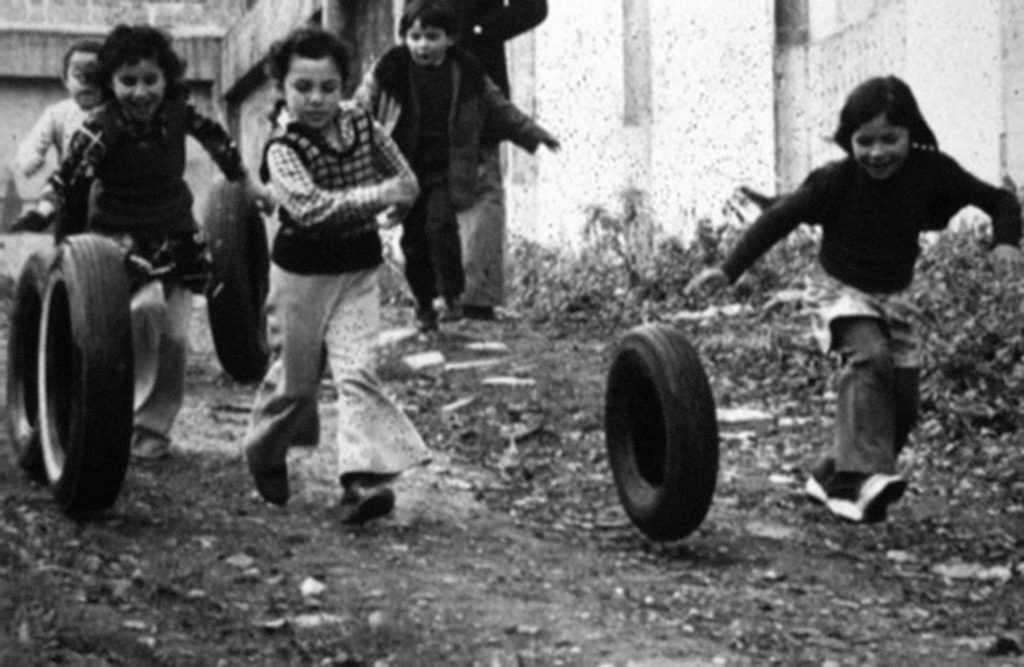
The side façade features a lightbox displaying an archival photograph that recalls children playing with car tyres on the vacant lot of the former Rasquinet factory in the 1970s. Together, these elements form an artistic reflection on the traces, stories and possibilities of free play in the city.
From Vacant Lot and Adventure Playground to Public Park
The story of the Rasquinet adventure playground begins with the bankruptcy of the Rasquinet factory on Josaphatstraat in Schaerbeek in 1968. The site, covering about 20 acres, was left vacant and attracted the attention of Pierre Massart, a priest who was active in the neighbourhood by providing language support to migrant children. He saw the site as a safe place where children could play: away from the street and from the danger of traffic accidents.
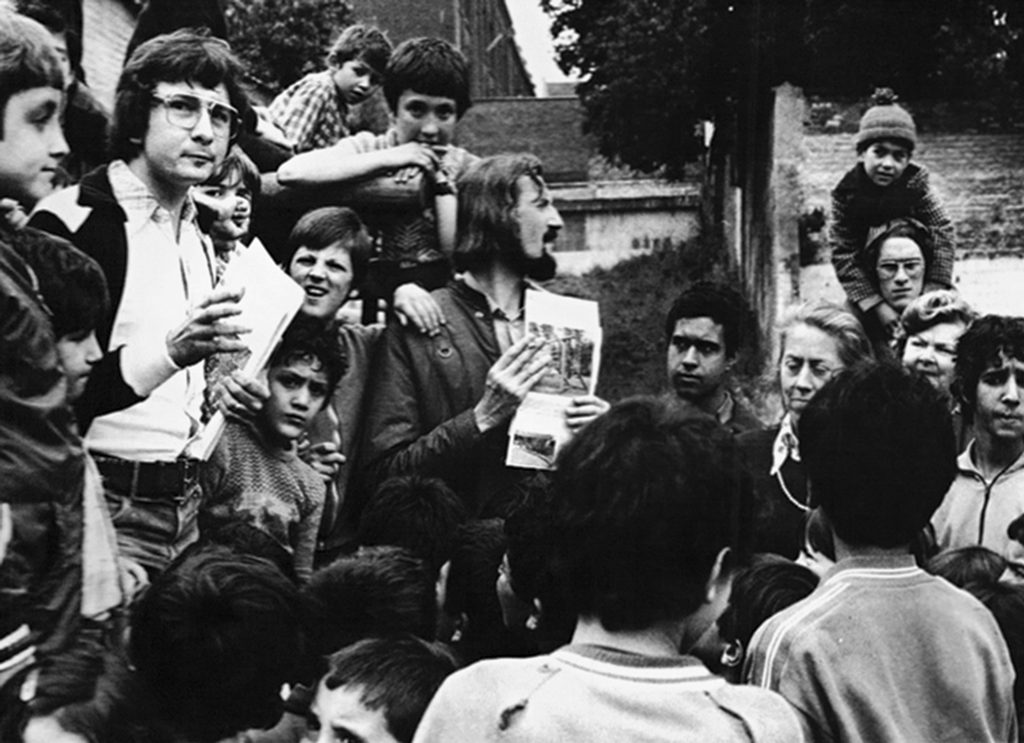
At the beginning of the 1970s, Pierre Massart started looking for volunteer facilitators and organized play and craft activities for neighbourhood children on Wednesday afternoons and Saturdays. The factory buildings were demolished, creating a large vacant lot. Inspired by the concept of the terrain d’aventure (adventure playground), which gained popularity in Europe from the 1970s onwards, he had materials such as wooden planks and car tyres brought in so that children could build their own huts. In this way, the Rasquinet adventure playground emerged, which was set up again every summer holiday from 1974 to 1978.
At the same time, local residents were campaigning to transform the site into a green public space in this densely populated migrant neighbourhood. This clashed with the mayor, Roger Nols, who was known for his racist views and open sympathy for the far right, and who had plans to build social housing there. The municipality complained about pollution on the site and closed it off with a fence. The residents did not accept this: demonstrations followed in which the fence was broken open and the site was reoccupied. During a playful protest action, children released balloons with cards that read: “Bons baisers des gosses du Rasquinet” (“Kisses from the kids of Rasquinet”).
In 1979 the municipality definitively closed the site with a fence, bringing an end to the children’s adventure playground on the Rasquinet site. Nevertheless, the residents’ struggle for a public space continued until their voices were finally heard in 1994, following a political change.
In 1999 the park was officially opened. It consists of a green area with gently rolling slopes. In the centre there is a small, traditional playground with a climbing frame and sandbox, while at the back there is a paved square where children can play football and basketball.
The initiative that Pierre Massart started in the 1970s continues today through Rasquinet ASBL, based in a building on Josaphatstraat, a little further down from the park. In contrast to the 1970s, the Neighbourhood Life service of the municipality of Schaerbeek now plays an active and positive role in involving residents in organizing activities in the park.
Credits for archival material:
Light box (exterior façade): Children play on the wasteland that emerged following the demolition of the former Rasquinet factory buildings in the 1970s, Schaerbeek/Brussel, undated (1970s), photo courtesy of the Asbl Rasquinet Collection.
Back wall (shop window): Children construct a hut on the wasteland of the former Rasquinet factory buildings in the 1970s, Schaerbeek/Brussels, undated (1970s), photo courtesy of the Asbl Rasquinet Collection.
Lisa Matthys is a contemporary artist whose work explores social themes, using art as a means of reflection, intervention and change. She works across disciplines such as installation, video, photography and participatory projects, often placing children at the centre of her practice. Her work explores free, unregulated play as a form of resistance to a society driven by efficiency and profit. Play thus becomes a space for imagination, slowness, collectivity and intuition.
www.lisamatthys.com
Annelies Vaneycken is an artist, designer, researcher and lecturer. Her practice lies at the intersection of design, art, politics, social engagement and everyday life. She develops supportive structures, spaces for dialogue and public narratives that question and challenge normative perspectives on social groups, with the aim of contributing to a more inclusive society. Through Office for Public Space, she creates space for children’s culture and free play in the city.
www.anneliesvaneycken.be & officeforpublicplay.org